
Visualising a Concept Worth Over $1 Million in Research Funding
Turning a complex food systems research proposal into a single image clear enough to help win one of Australia’s most competitive research fellowships.

Turning a complex food systems research proposal into a single image clear enough to help win one of Australia’s most competitive research fellowships.
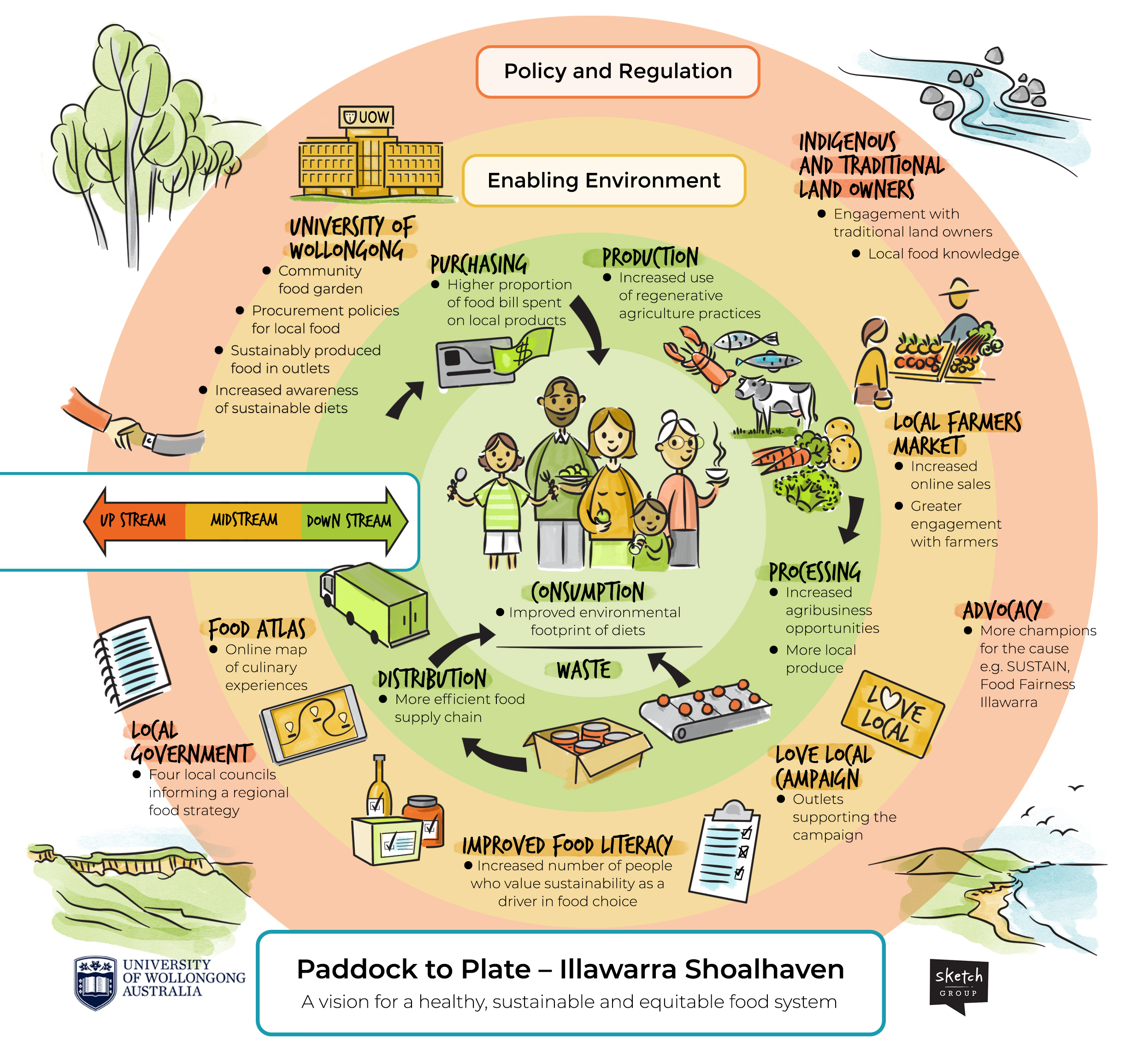
Professor Karen Charlton, then at the University of Wollongong, was preparing an application for an ARC Future Fellowship, one of Australia’s most competitive research funding schemes. The numbers alone make the challenge clear: in the funding round she applied for, the Australian Research Council received 627 applications nationally, with an overall success rate of just 15.9%. At the Professor level Karen was applying for, the success rate was even tighter, 14.7%, and in her specific field, food systems research, only five applications were funded across the entire country.
Karen’s research vision, a healthy, sustainable, and equitable food system for the Illawarra Shoalhaven region, was genuinely systemic: it touched production, processing, distribution, consumption and waste, alongside the policy settings, institutions, and local stakeholders needed to make it work. Explaining that scope in prose risked losing an assessor before the point landed. She needed a single image that could hold the whole system at once.
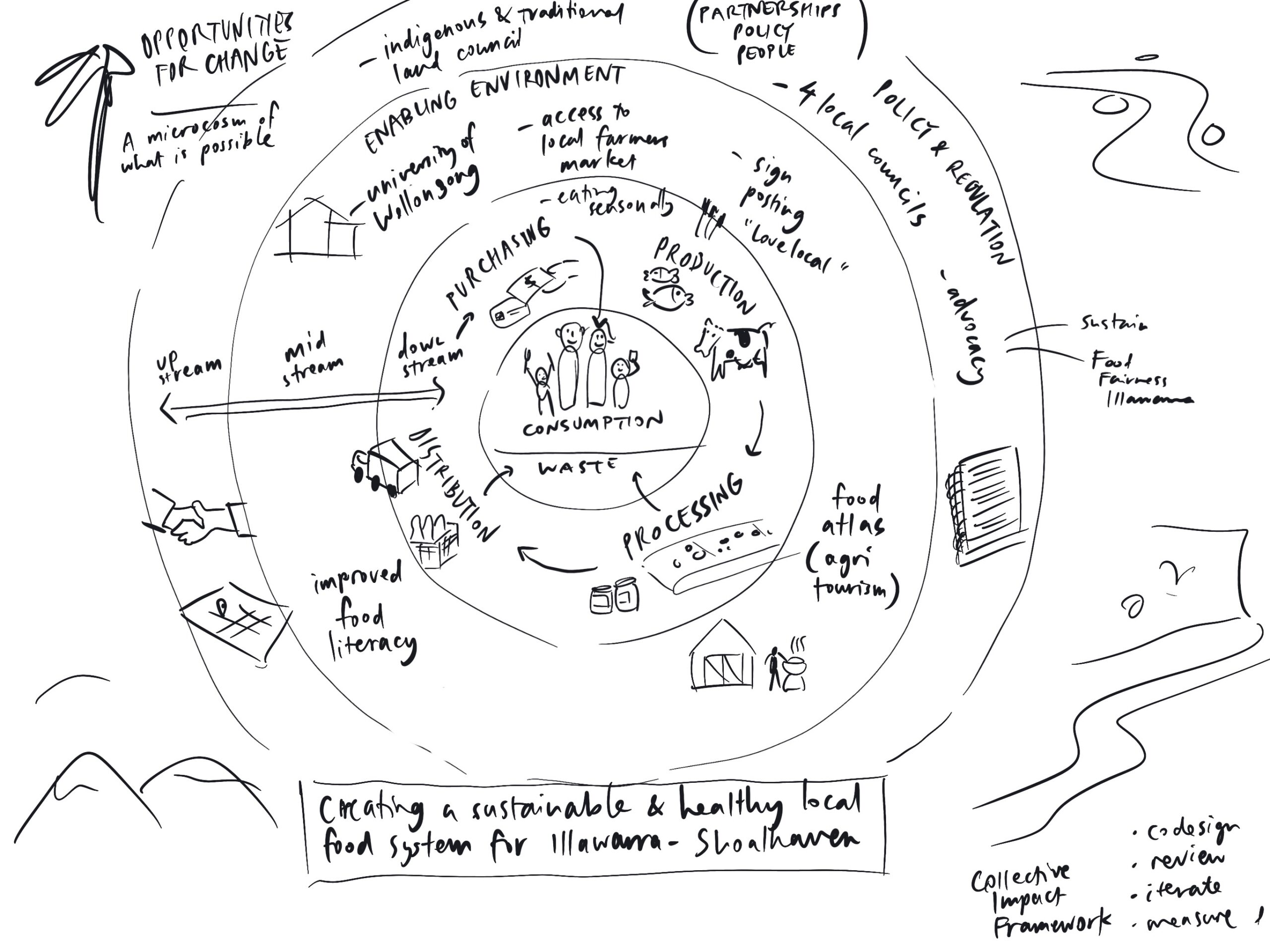
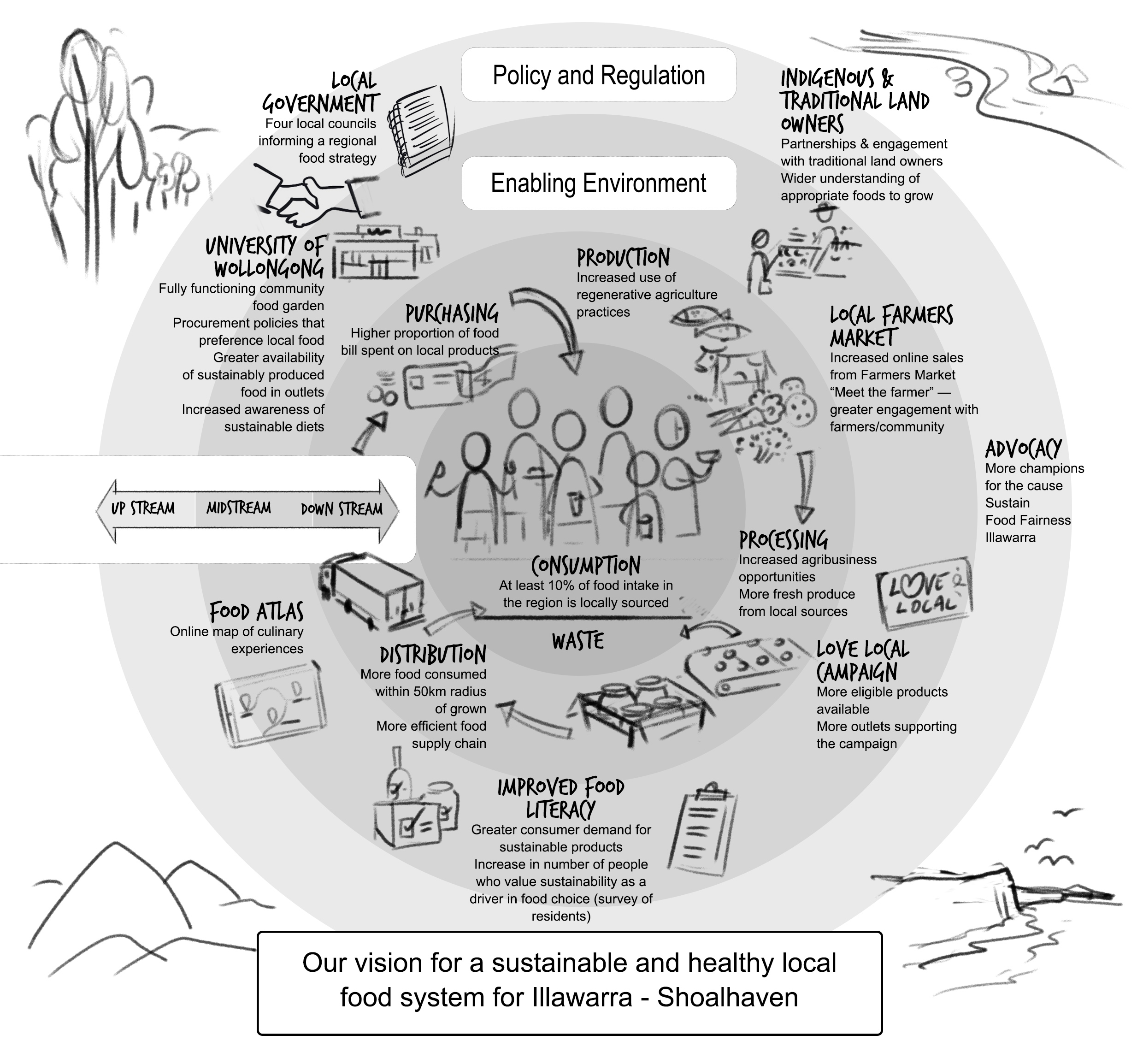
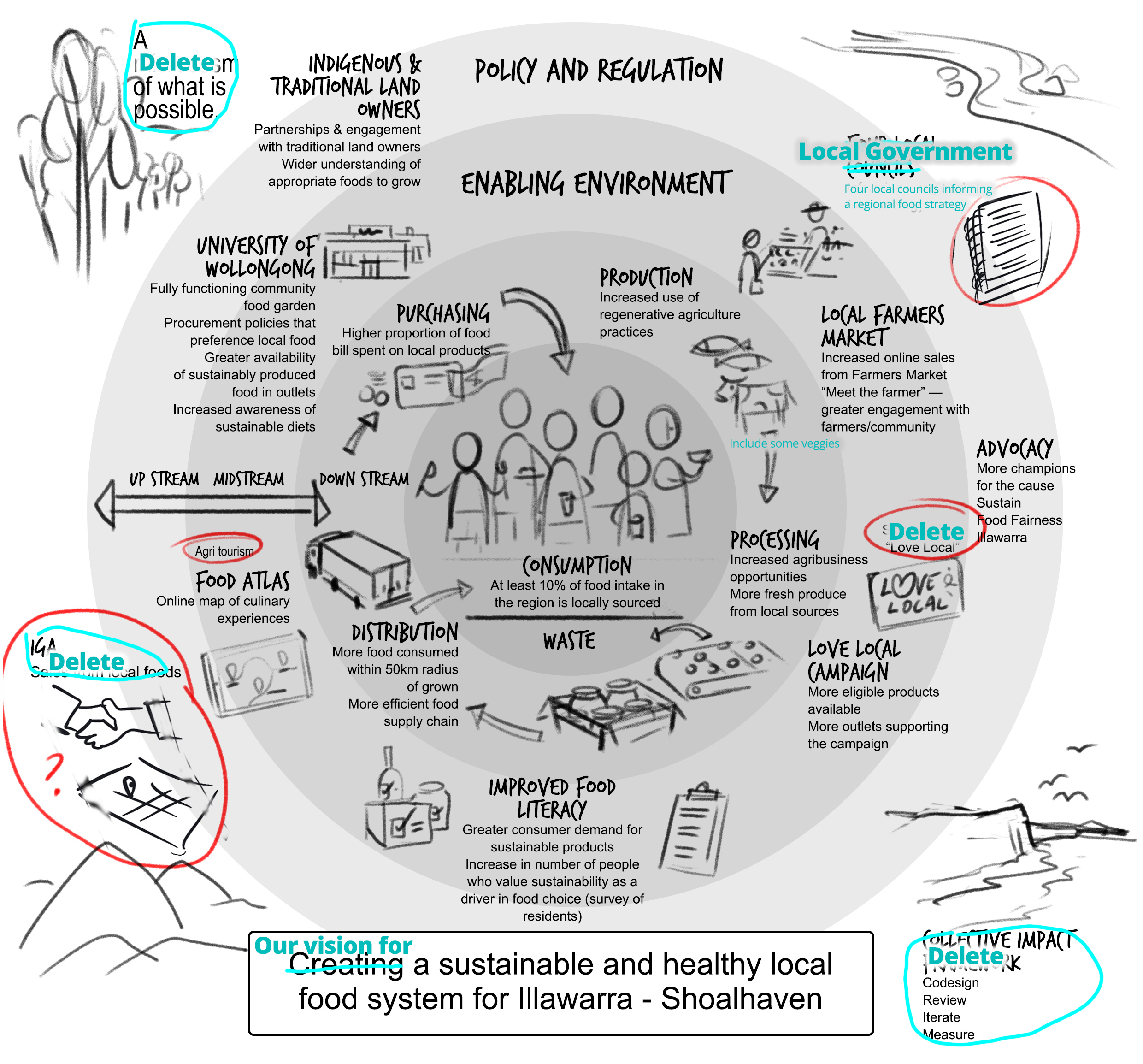
Karen came to us with a clear starting point: reference examples of food systems diagrams she liked, and a request to ground the framework in her own region by using the Illawarra Shoalhaven as the visual backdrop rather than leaving it abstract. We ran a visualisation session to map out the structure before committing to detail, then iterated closely with Karen through several rounds, including trimming back on-page text after a colleague’s feedback that the first pass was too dense for a grant assessor to take in quickly.
A single circular systems map, upstream to downstream, moving through Purchasing, Production, Processing, Consumption, Waste, and Distribution at its centre, surrounded by the Enabling Environment and Policy and Regulation that shape the whole system from outside. Rather than leaving those categories generic, we populated them with the real stakeholders of the Illawarra Shoalhaven region itself: the University of Wollongong, Indigenous and Traditional Land Owners, the Local Farmers Market, local government, advocacy groups like SUSTAIN and Food Fairness Illawarra, the Love Local campaign, and a regional Food Atlas. The result reads less like a generic framework and more like a portrait of an actual, specific place.
The application was successful. Karen was awarded an ARC Future Fellowship worth $1,066,940 over four years for her project “Creating a sustainable, healthy, and equitable food system”, one of only five awarded nationally in the food research category that year. Given how sensitive grant applications are before an outcome is known, Karen asked us to keep the image out of public circulation until results were confirmed; we used it selectively with prospective clients during that window, and it was released more broadly once the Fellowship was announced.
The image has since taken on a life well beyond the original application. Food Fairness Illawarra now uses it publicly to explain the project and to advertise two PhD scholarships it funds, one focused on creating enabling environments for local food solutions, the other on co-designing food system change through stakeholder partnerships. Real-world partners since brought on board, Healthy Cities Illawarra, Food Fairness Illawarra, and four local governments, closely mirror the stakeholders the original visual mapped out, evidence that the image didn’t just win the funding, it’s still doing the job of explaining the vision years later.