
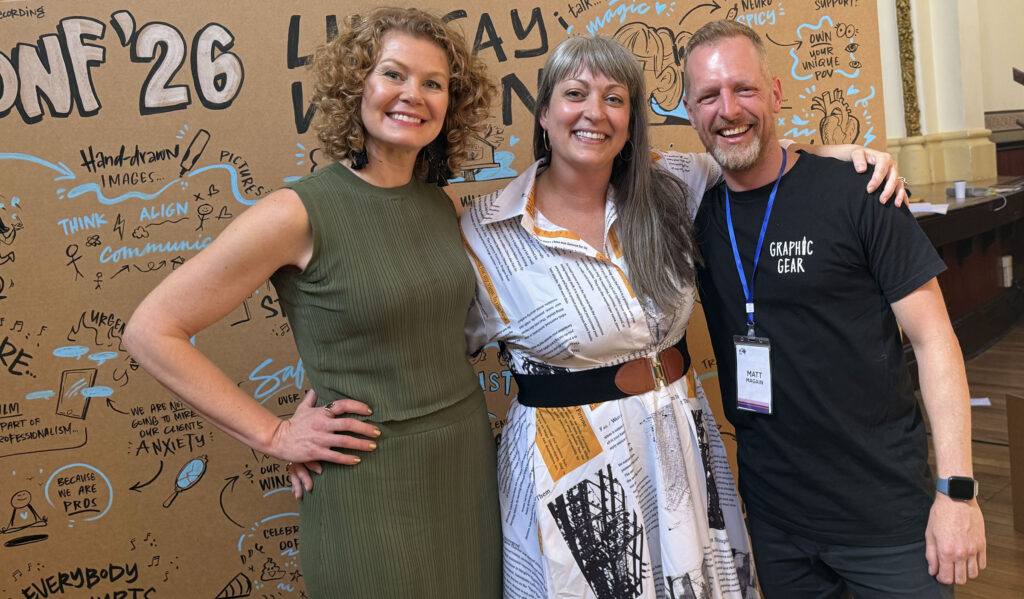
Last week I attended VizConf 2026, and I left feeling something I didn’t realise I’d been missing: nourishment.
Not in the “I learned a new technique” sense (although I did). More in the deeper sense of being reminded that this is my community.
Over the last few years I’ve been putting so much energy into growing my business skills: improving sales systems, sharpening strategy, expanding my network outside the visual thinking world. All good things. But somewhere along the way, I forgot what it feels like to be in a room full of people who get it. People who speak the same visual language, respect the craft, and who understand the weird mix of artistry, listening, synthesis, performance, and professionalism that comes with this work.
It was pretty nourishing to be reminded that there are people in this community who respect me too. A couple of people (you know who you are!) even told me that they were inspired by some of the things I’ve done, which hit me right in the feels.
The panel: Managing the Ebb and Flow
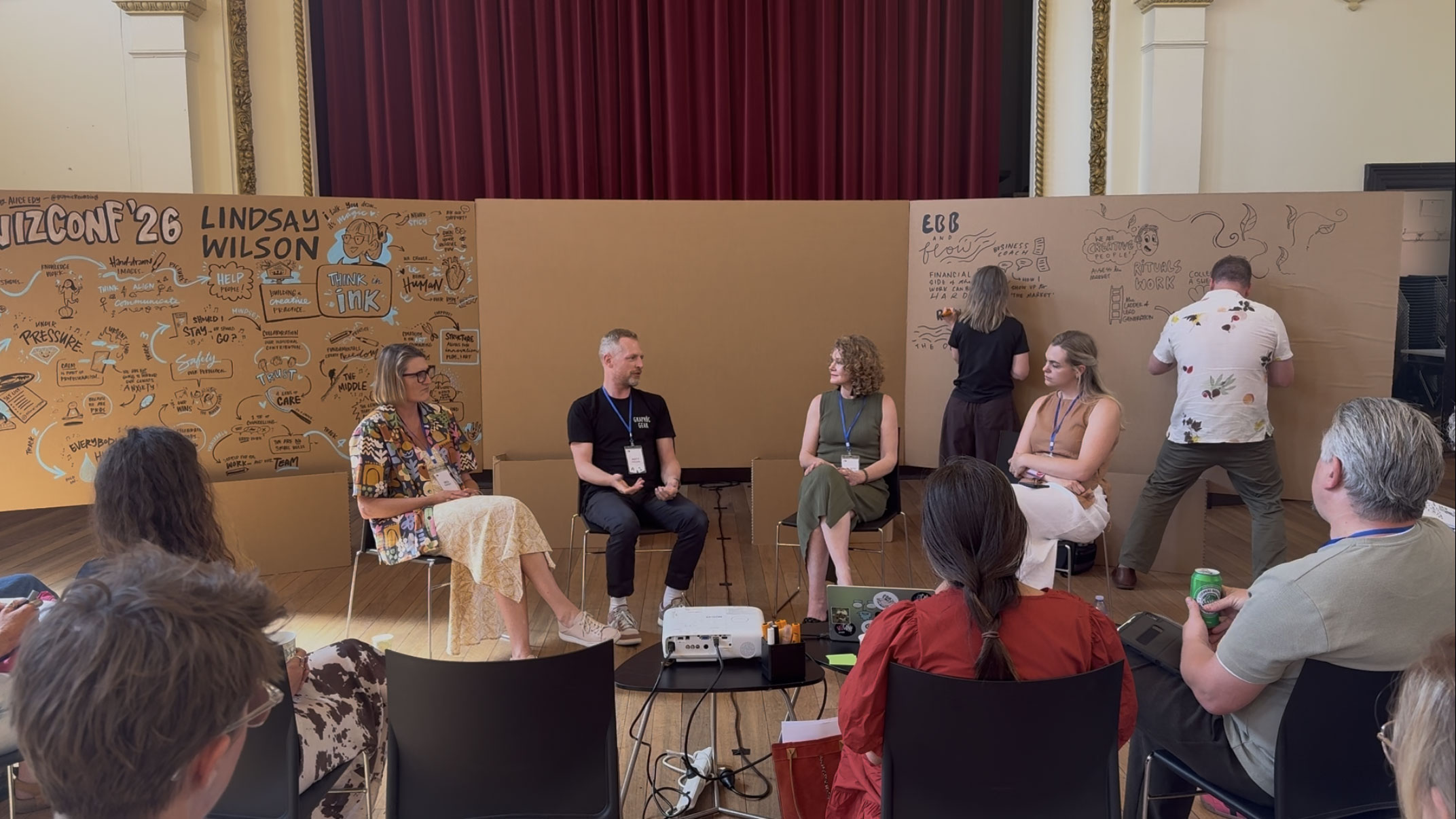
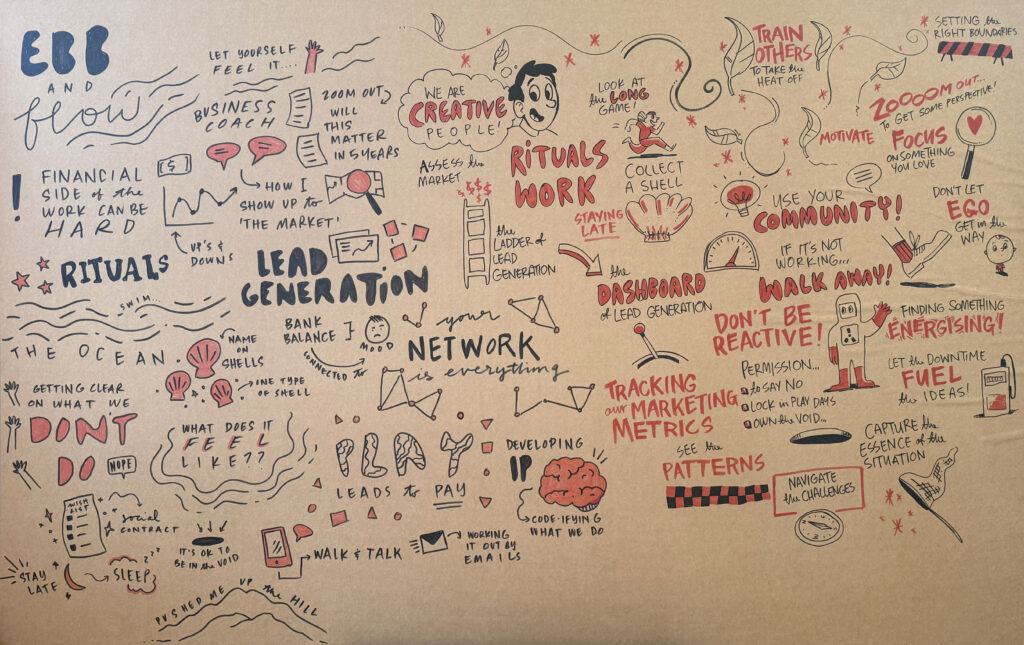
One of the highlights for me was being invited to join the panel “Managing the Ebb and Flow”, alongside Indi Tansey (Indi Dust) and Dusty Folwarczny (Ink Factory), and facilitated by Tatum Kenna.
We spoke about the realities of building a creative practice: the unpredictable seasons, the emotional rollercoaster, the pressure of staying relevant, and the constant question in the back of every freelancer or studio owner’s mind:
Where is the next piece of work coming from?
When it was my turn, I shared a perspective I’ve been thinking about a lot lately, particularly as I’ve been working to stabilise Sketch Group’s pipeline.
In the sales world, people often talk about the “ladder of lead generation”: you climb from one tactic to the next, as though there’s a single linear path you’re meant to follow up and down depending on how busy you are.
Implicit in this model is that
- “top of the ladder” activities (writing a book, public speaking) are considered noble because they pull work to you
- “bottom of the ladder” activities (cold calling, cold email, cold direct messaging) are considered ignoble because they require that you push for the work
- “middle of the ladder” activities (social media, paid ads, partnerships, referral programs) are considered easier wins
I don’t think lead generation needs to work like that.
Sure, I plan on aiming for more of those top-level activities. But shooting off a DM or calling someone out of the blue is not something that I consider myself to be above. They all have their place.
What I want is more like a lead generation dashboard: a set of levers I can pull depending on the season, the capacity of the team, and the kind of work we want more of.
And yes… I may have also teased a little of the Visual Operating System work I’ve been developing, including the book I’m planning on writing this year. It was a small moment, but it felt meaningful to share it in that room, with that audience. VizConf feels like exactly the kind of place where ideas like that belong.
Peeking behind the curtain at Ink Factory
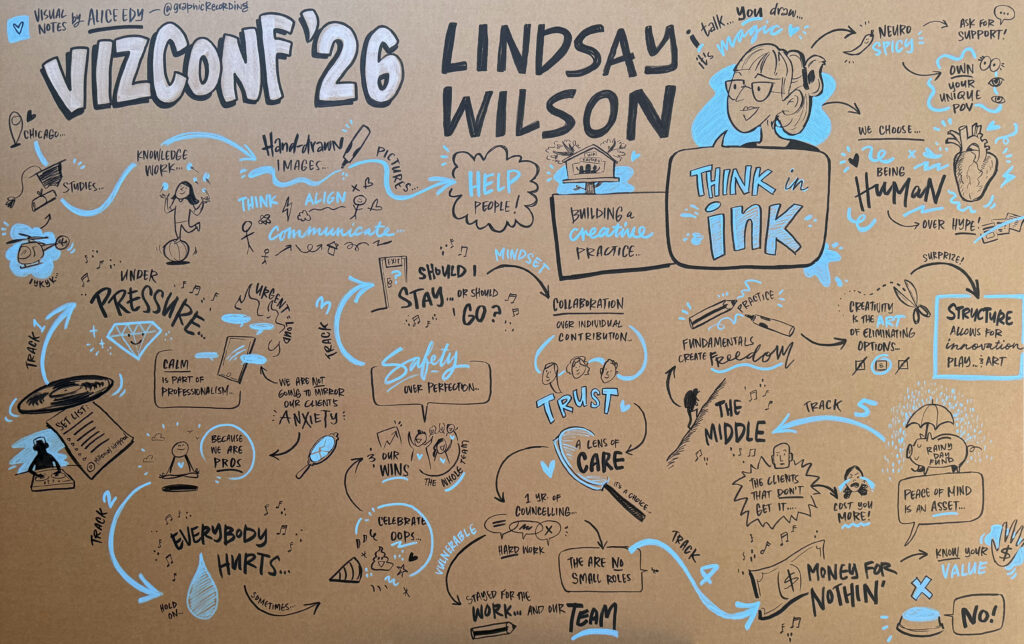
Another big moment for me was attending a two-day workshop with the founders of Ink Factory, alongside a group of other professional graphic recorders.
It was genuinely inspiring to get a behind-the-scenes look at a studio that, in many ways, resembles what we are building at Sketch Group.
Dusty, Lindsay, and Ryan have built a business with a clear house style, and they actively train their team to show up and capture events “The Ink Factory way”.
As someone who’s spent years thinking about how to scale quality without losing the magic, it was both inspiring and strangely comforting to see that the answer isn’t “hope for the best.”
It’s training. Systems. Creative direction. Standards. Time.
At Sketch Group our philosophy has always been that diversity in style is a strength, so seeing up close what is kind of the opposite approach gave me plenty to think about. There’s a version of this work where defining a style and maintaining a standard is possible, even as the team grows.
Style, identity, and staying true to your hand
I also attended a workshop with my friend, referral partner, co-author, and occasional competitor, Jessamy Gee, on developing your own style.
It was valuable in its own right, but it also landed even more strongly in the context of the Ink Factory workshop.
On one hand, there’s something powerful about a house style—a shared visual language that allows a team to scale, and a brand to feel coherent.
On the other hand, there’s something deeply human (and deeply satisfying) about developing a style that feels unmistakably like you.
The exercise we completed reminded me that style isn’t just aesthetic. It’s identity. It’s confidence. It’s the mark you leave on the work.
Maybe that’s part of what makes VizConf special: it’s one of the few places where you can have conversations like that with people who truly understand what’s at stake.
Closing thoughts
I came home from VizConf feeling recharged: creatively, emotionally, and professionally.
It reminded me that while I’m building a business, I’m also part of a craft, and a community that exudes generosity, abundance, and heart.
Lindsay from Ink Factory reminded us all that we are luck to have such an incredibly supportive, open visual thinking community in Australia and New Zealand, and that it is unique, and must be fostered and nurtured. There are decades-long thread of relationships, shared experiences, and mutual respect mixed up in the GRA and VizConf that I don’t want to take for granted.
So yes, I learned things. I took notes. I had ideas.
But more than anything, I left feeling full. For this I am very grateful.