
You don’t need to be an artist to communicate feelings, ideas, or actions. All you need is a pen or marker – and a box. Box figures are one of the most powerful and accessible tools in visual communication.
Unlike a stick figure – which is essentially just a circle on a line – and a box figure has a body. That body can lean, twist, crouch, and soar, instantly telling a story with just a few lines. Whether you’re sketching ideas in a meeting, creating a whiteboard animation, or mapping out a storyboard, box figures let you communicate what words often can’t.
Here’s what they give you:
📐 Identify Angles
Instantly see which direction a character is facing — side-on, front-on, or at an angle — just by rotating the box.
⚡ Express Motion
Use “squash and stretch” principles to show dynamic action. A tilted, stretched box reads as movement before you even add the legs.
💬 Convey Emotion
Lean into the pose. Pair your figure with the Emotions Matrix to tell a story without a single word.
It All Starts With the Box
The “box” doesn’t need to be a perfect rectangle. In fact, it’s the variations that make things interesting. Simple tweaks to the body shape give your characters a whole new range of emotions and actions — before you’ve even added arms or legs.
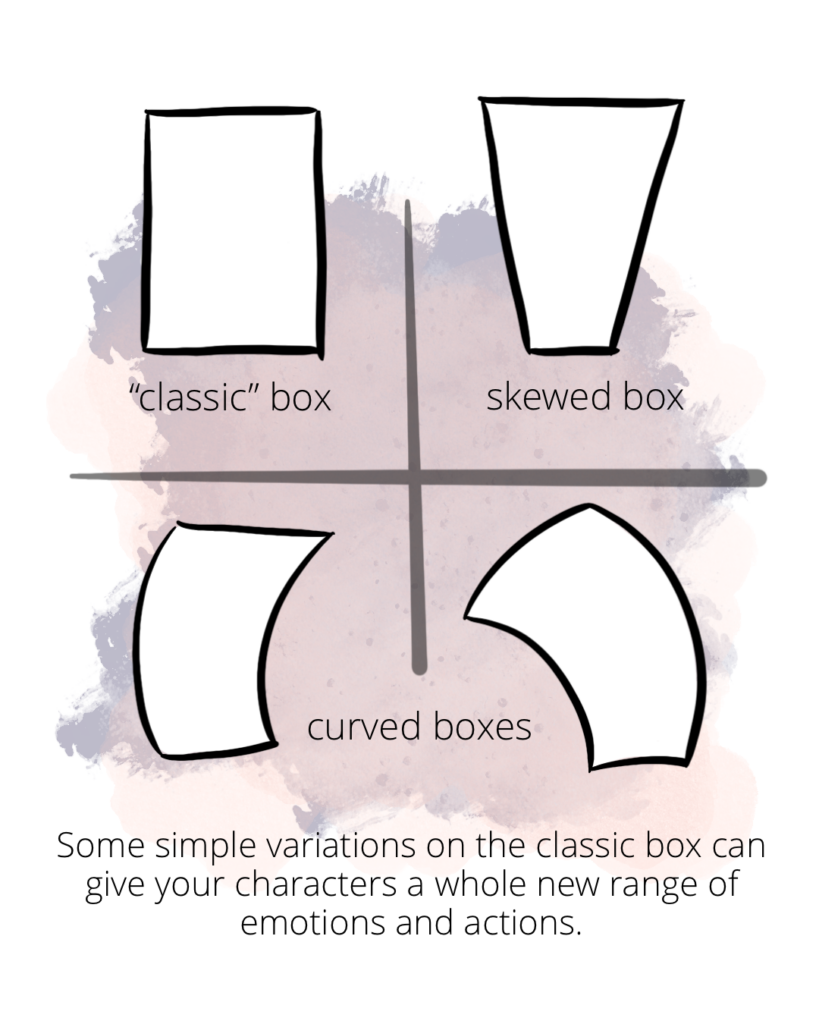
- The “Classic Box”. Upright and neutral. A great starting point for any standing figure — think of it as your default body position before anything interesting happens.
- The Skewed Box. Wider at the top or bottom. Perfect for showing depth, a three-quarter view, or giving your character a sense of weight and grounding.
- Curved Box. Organic and rounded. These are ideal for bent-over, crouching, or relaxed poses — any time you want to suggest softness or a body in motion.
The secret isn’t in perfect lines — it’s in the angle and shape of the body. Once you understand that, the rest follows naturally.
01 — Sitting at a Computer: Side View
The side view is one of the most readable poses you can draw. A curved box for the torso instantly sells the “leaning forward” posture of someone working at a desk — no shading, no detail required.
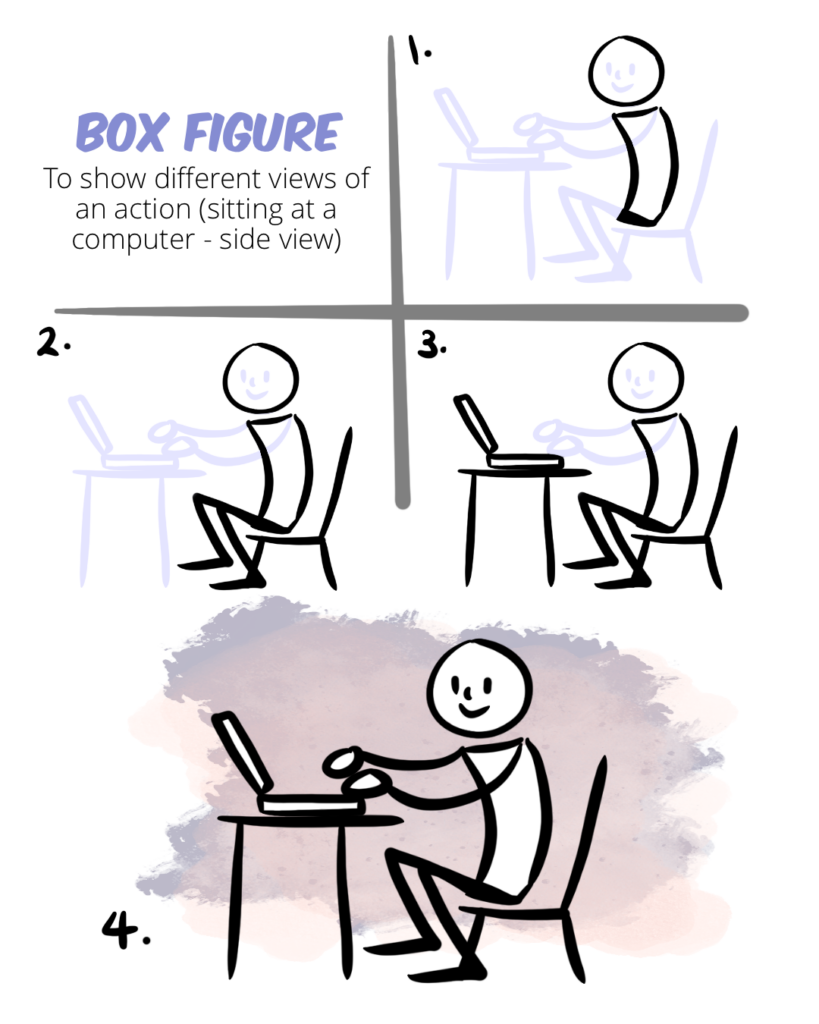
- Start with the head and a curved box. Draw a circle for the head, then sketch a curved or slightly bent box for the torso. Tilt it slightly forward — this alone reads as “sitting and engaged.”
- Add the arms and leg lines. Extend arms forward toward where the keyboard will be. Add bent legs below the box — two angled lines is all you need to suggest a seated position.
- Drop in the desk, chair, and laptop. Simple horizontal lines for the desk surface and laptop lid. A suggestion of a chair behind the figure completes the scene. Keep these elements light — they’re supporting cast, not the star.
- Add expression and refine your lines. The finished figure reads instantly as someone focused and working — all from a tilted box and a few confident strokes.
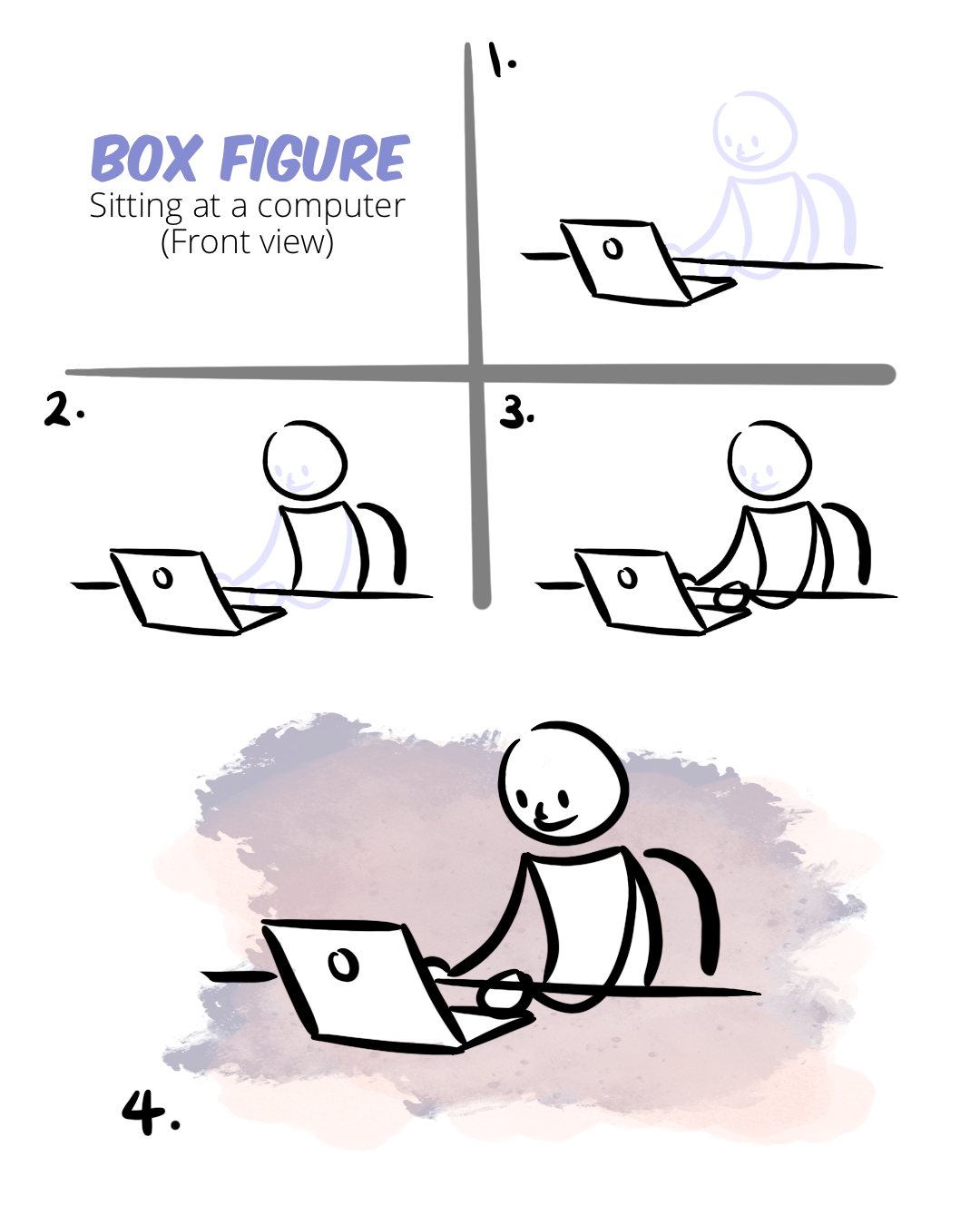
02 — Sitting at a Computer: Front View
The same action, a completely different perspective. The front view is ideal when you want your character to feel like they’re looking directly at the audience — a great choice for explainer video moments that need to create connection.
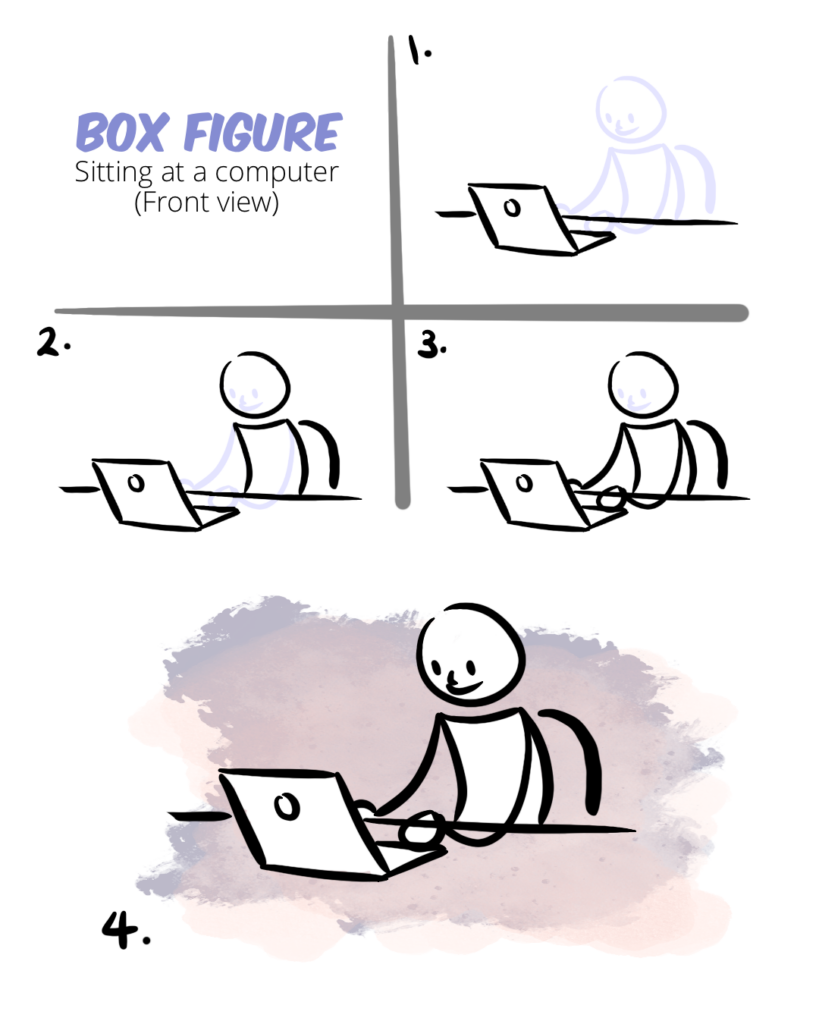
- Sketch the laptop first. Start with a simple wedge shape for the laptop at the bottom of your frame. This anchors the scene and tells you exactly where to position the figure above it.
- Place the head and a compact curved box. From the front, the torso appears smaller and more compact. A gently curved box behind the laptop suggests the figure is leaning slightly toward the screen.
- Add arms and a simple face. Arms reach down toward the keyboard, elbows bent outward. Even tiny facial features — two dots and a curve — bring the figure to life immediately.
- Refine and finish. The front view creates connection — your character is almost looking directly at the viewer. Perfect for moments when you want to build rapport in a video.
03 — Showing Movement: The Cartwheel
This is where box figures really outshine stick figures. Because the torso has volume, you can rotate it, tilt it upside down, and the figure still reads clearly. Try doing that with a stick!
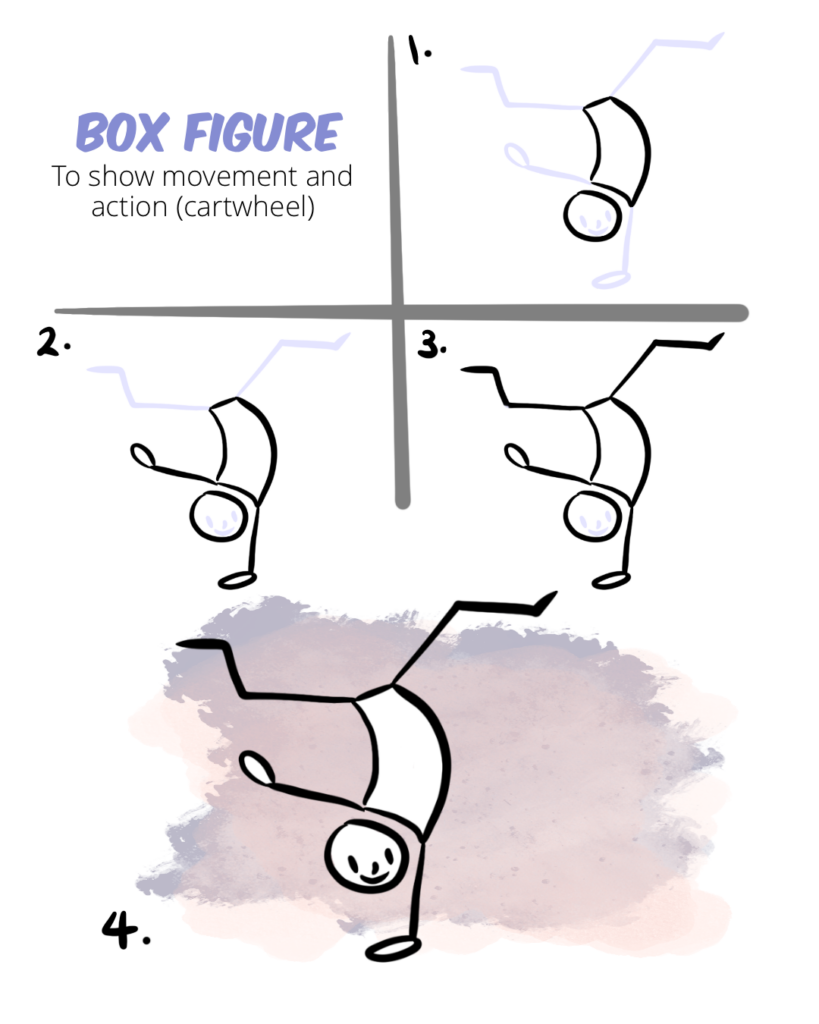
- Flip the box and the head. Start upside-down — draw the head near the bottom of your space, and a curved box arcing above it. This inverted position immediately suggests mid-air movement.
- Add one arm reaching down. Extend one arm to the ground — this is the weight-bearing arm of the cartwheel. A single curved line from the shoulder to a small oval “hand” is all you need.
- Splay the legs outward. Two legs extending in opposite directions from the hips — one up, one down — captures the classic cartwheel silhouette. Angled lines with small feet do the job perfectly.
- Add expression and refine. Bold, dynamic, and unmistakeable. A joyful expression and clean lines give you a figure bursting with energy. No artistic training required.
04 — Showing Urgency: Running Away
Want to show urgency, escape, or speed? The running figure is a visual shorthand that works instantly in any whiteboard or explainer context. And the key to making it work is surprisingly simple: it’s all in the tilt of the box.
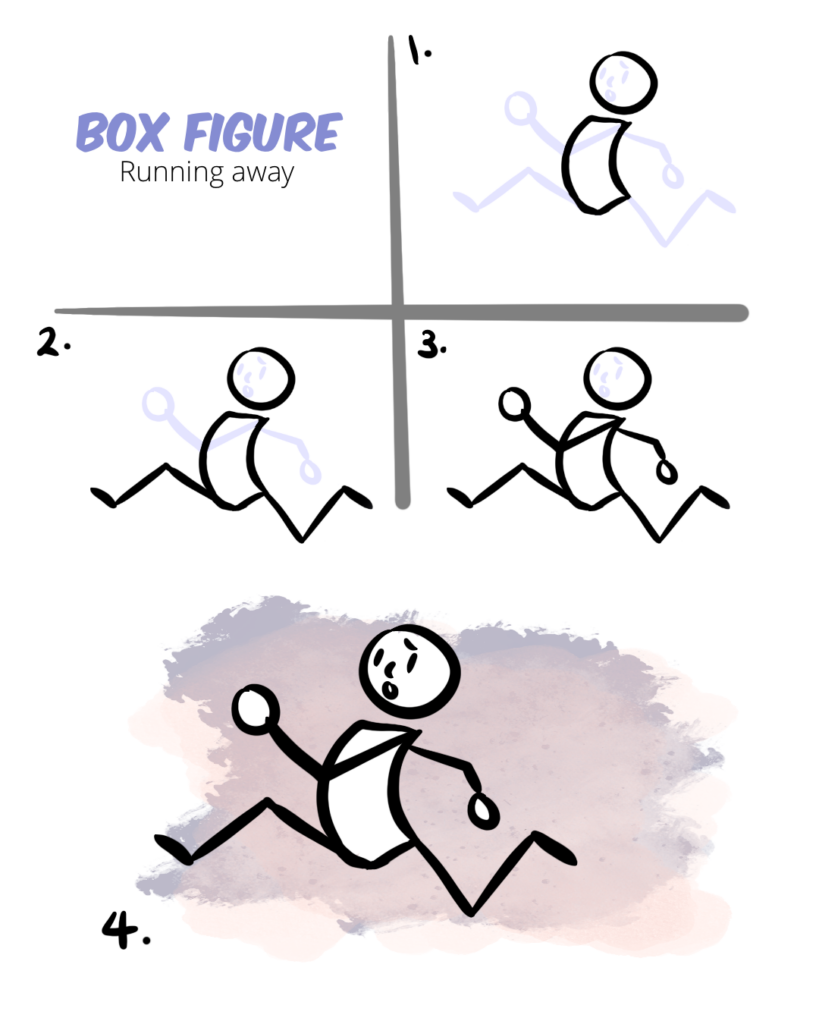
- Tilt the box forward at an angle. A body leaning forward shows speed before anything else is drawn. This one change is the difference between “standing” and “running.”
- Add the pumping arms. One arm swings forward, one swings back — opposing each other. Keep them bent at the elbow. A small oval for each fist is enough detail.
- Draw the legs mid-stride. Zigzag legs in an asymmetric stride — one forward, one kicking back. The more exaggerated the angle, the faster the figure appears to move.
- Add the expression. A worried or determined face layers in the emotional story. The tilt of the box does most of the heavy lifting — the face just reinforces it.
05 — Showing Feelings: Jumping for Joy
Sometimes you don’t need to illustrate an action at all — you just need to show how someone feels. Box figures are brilliant at this, especially when paired with expressive body language and a face that matches the energy.
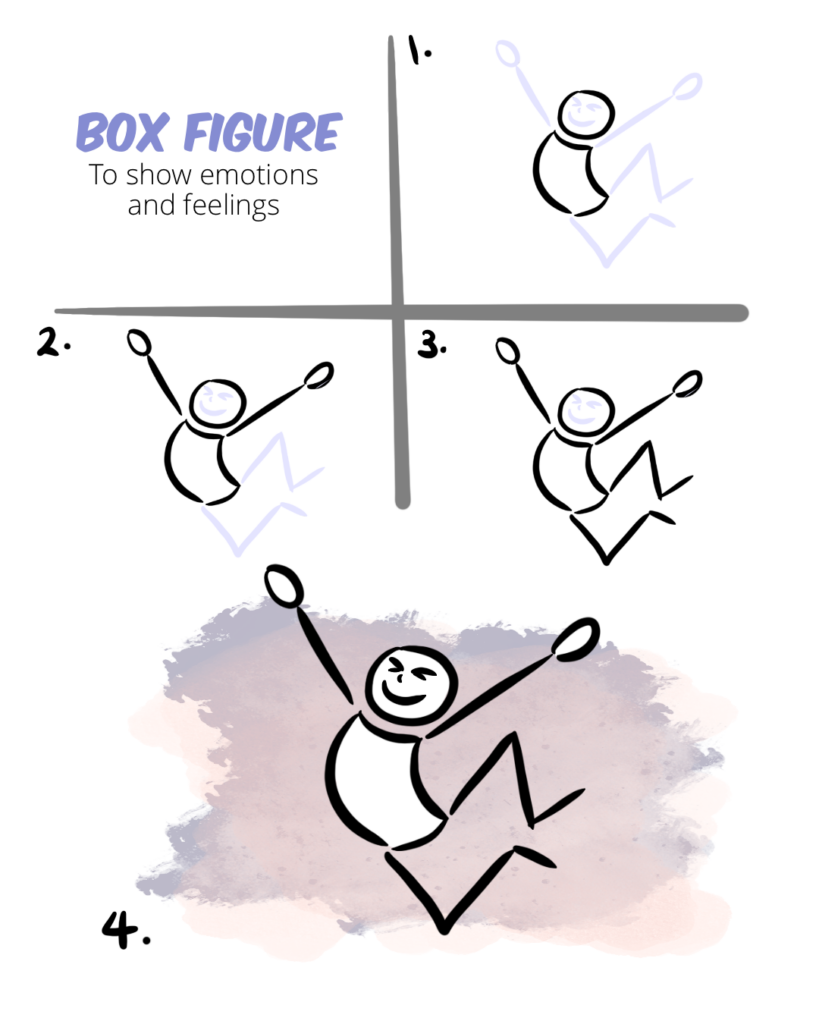
- Place the box up high on the page. Leaving space below the figure creates the visual impression they’re airborne. You don’t need to “draw” a jump — you just need to imply it through placement.
- Throw one arm up. A single raised arm with an open hand shoots energy upward. This is one of the most universal visual signals for celebration or excitement.
- Bend the legs and add a kick. Bent or kicking legs below the box reinforce the mid-air feeling. Sharp, angular lines create energy; looser, curved lines create playfulness.
- Add the big grin. Arms wide, legs kicking, face beaming — pure delight. This figure communicates joy instantly, across any language or culture. That’s the power of visual communication done well.
Mix, Match, and Make Them Your Own
Box figures can come in all shapes and sizes. A wide, solid box feels different from a tall, narrow one — and that’s a good thing. Varying the body shape of your figures adds personality and helps your audience distinguish between different characters in a scene.
Once you’re comfortable with the basics, combine your box figures with the Emotions Matrix to add another layer of storytelling. The same pose can read as excited, nervous, or triumphant depending on the face you pair with it. Body language and facial expression working together give you a complete emotional picture — no words needed.
Ready to Give It a Go?
Grab a pen, sketch a box, and start telling visual stories. You’ll be surprised how quickly it becomes second nature — and how much clearer your ideas become when you put them into pictures. Research consistently shows that visuals are are more likely to be remembered. Box figures put that advantage within reach of everyone.
If you want to explore the wider world of visual thinking, we offer a range of visual thinking training courses is a brilliant place to see how people around the world are using simple drawings to capture and share ideas.