
About a year ago I posted quite excitedly on a Facebook Group for Graphic Facilitation—the largest community for that kind of work—that I was close to publishing a case study with some solid data that convincingly demonstrated the value of graphic recording and graphic facilitation.
I wasn’t trying to showboat, but it may have come across as such. The thing is, it’s so rare for us to get hold of good quality data that validates the impact of what we do, so I was genuinely giddy about sharing this data.
Well, as with so many things that are worthwhile, it took longer than expected to pull together, get the OK from the powers that be, and present in a format that did the information justice.
However, today I am very proud to announce that the case study for this engagement is online, as is the first ever Sketch Group Research Report, available to read, use, and share. It is based on our engagement with the Transformation Team at St. Vincent’s Hospital Melbourne (SVHM).
The team came to us several years ago with a genuinely hard question.
The Royal Commission into Victoria’s Mental Health System had just found that people with lived experience of mental ill-health had been systematically underrepresented in decisions about the services meant to support them. SVHM wanted to fix that.
But how do you run a consultation process that’s genuinely accessible to people navigating active mental health conditions, cognitive load, or a long history of not being heard, without just reproducing the same power imbalance in a different format?
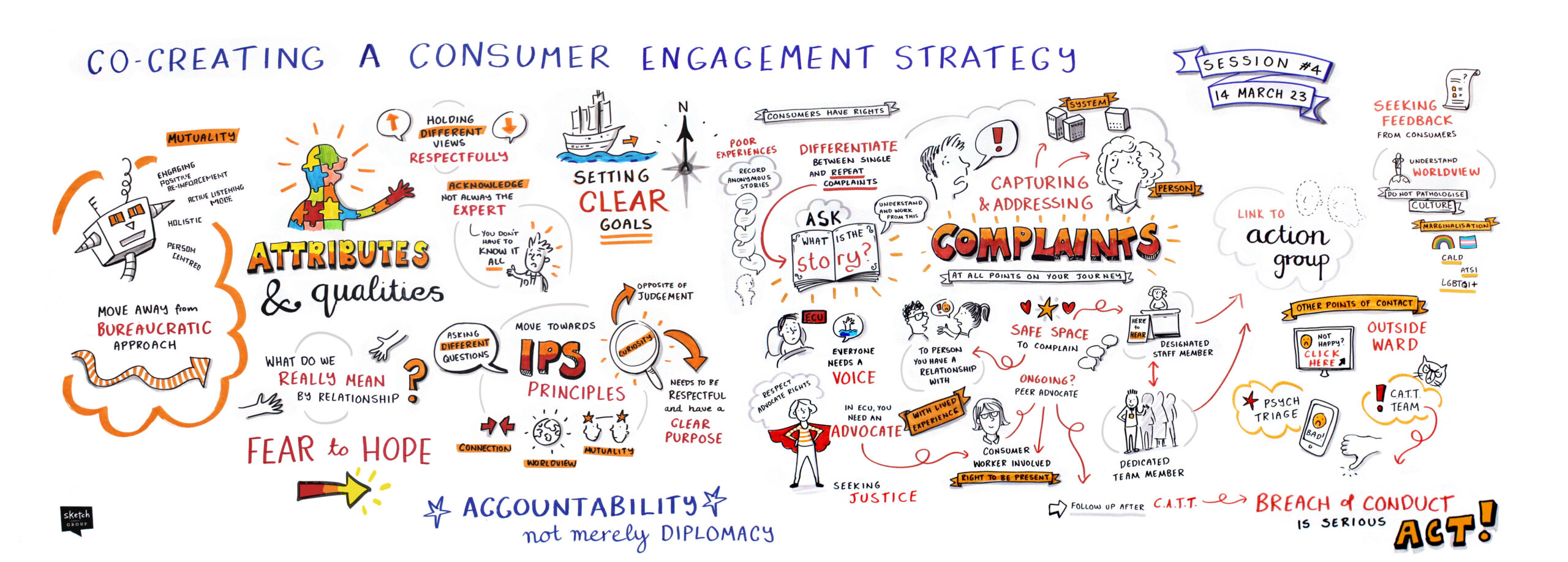
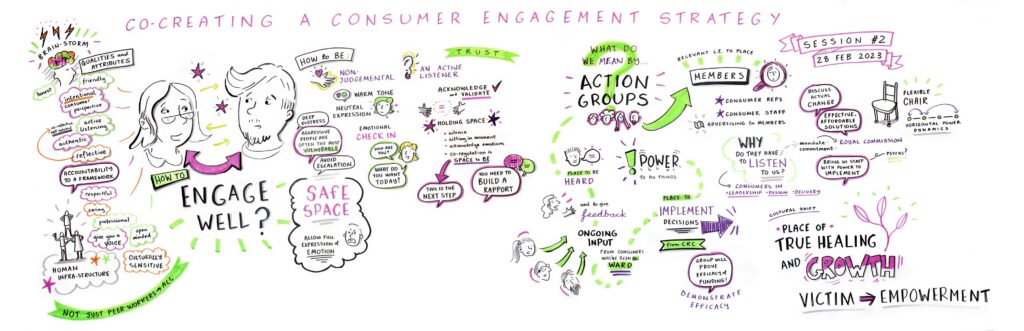
Their hypothesis: put an illustrator in the room. Capture every conversation live, visible to everyone, the whole time.
We co-facilitated 19 sessions over two years. Consumers in inpatient wards. Carers at their first ever focus group. Clinical staff and decision-makers. The results held steady across every group we measured:
- 95% enjoyed the process.
- 92% felt listened to.
- 87%+ reported improved attention and idea generation.
- 95% of staff rated the sketch more useful than written minutes.
(Unsurprisingly, not one person, across any cohort, preferred the written minutes!)
One consumer told us:
Thank you for having this session, usually managers and services don’t really want to hear what we have to say but you really listened to us. It is cool to see all our ideas up there.
That line stuck with me. Not because it’s a nice testimonial, but because of what it reveals about what usually happens in consultations like this.
The project was significant enough that SVHM’s own clinical staff presented the findings at two national conferences. We’re proud of the part we played in it, and prouder still that it gave people a genuine, visible say in decisions about their own care.